



Jon Schreibfeder, STAFDA Inventory Consultant: Money or Glory
Why are you in business?
 |
 |
You can be in business for one of two reasons, the money or the glory. My father was a great guy and a great salesman. But it seemed he was never quite satisfied unless he saw a lot of activity in the office of our family-owned industrial distributorship: people screaming into phones, running out to the warehouse and
constantly rushing around with concerned expressions.
Several employees developed an expression to describe this general atmosphere of confusion: “When in doubt, run in circles, scream and shout.” Dad often confused activity with productivity. He received a lot of satisfaction solving continual crises (often created due to bad inventory management or control) in Superman fashion and going home dead tired after a long day at work. Dad was in business for the glory!
There was one problem. This extra activity always cost us money. Our cost of doing business was higher than it should have been because:
- An emergency shipment had to be brought in by airfreight because a replenishment order wasn’t issued at the right time.
- A special truck had to be sent out to a customer because the wrong product or quantity was shipped on the initial order.
- Several warehouse workers had to spend several hours looking for misplaced material in the warehouse.
I have visited hundreds of companies and organizations throughout the world during the past 30 years. One thing I have noticed: The best managed and most profitable firms have offices and warehouses that are as quiet as libraries. Everyone goes about at a steady pace performing the tasks assigned to them. These companies are in business for the money. Their goal is to maximize their profitability (or minimize their costs) with the least possible amount of effort and resources. Crises are rare in daily activity. Every time a crisis occurs, time is taken to analyze:
- Why did the crisis occur?
- What can be done to prevent similar crises from occurring in the future?
This is the first in a series of articles designed to help you transform your business from being in business for the glory to being in business for the money. We will look at common problems faced by most distributors, outline typical underlying causes, and discuss remedies that you can implement to prevent crises from occurring in the future. This month we will discuss stockouts of “A” ranked products.
“A” ranked products are those items in your inventory that account for 80% of your sales activity. Typically these are the 10% - 13% of your products that are constantly being requested by your customers. In order to provide great customer service it is imperative that these items are nearly always available in reasonable quantities. Best practice is to insist an “investigation” take place whenever one of these products experiences a stock out.
Understand that stockouts are usually caused by reordering the product at the wrong time rather than ordering too little of the product. A reorder point or minimum quantity for an item with recurring sales should be made up of four components:
- The demand forecast (i.e. the quantity you predict you will sell or use)
- The anticipated lead time (i.e. the time you estimate it will take to replenish your stock of the item from the primary source of supply)
- The safety stock quantity (i.e., reserve inventory maintained in case you sell or use more than you estimated during the lead time or there was a delay in receiving a replenishment shipment)
- The order or review cycle (i.e., the normal length of time between receiving replenishment shipments from the primary source of supply)
Compare the demand forecast for the month to the actual quantity sold. If the quantity sold greatly exceeded the forecast, ask:
- Was there unusual sales or usage activity that will probably not reoccur in the future? If so, be sure to adjust usage history by removing the unusual sales.
- Are you experiencing the start of a new trend in sales or usage? Does your buyer need to immediately increase the stock of this product?
- Do you need different or enhanced forecasting tools to predict future usage of this item? If you are continually running out of products, you may need to better forecasting procedures or software.
Compare the lead time associated with the last stock receipt to the anticipated lead time in your system. If the shipment was late contact the vendor. If the delay was caused by a temporary condition that has been corrected no action is necessary. But if this new lead time will be the new “norm” immediately change the lead time in your computer system to reflect what the anticipated lead time will be for future shipments.
Does this item continually experience fluctuating demand or lead times? If there is no pattern of usage or consistency in lead times and it is important to maintain stock on this item, you must increase the safety stock or safety allowance for the item. This is the reserve inventory you maintain to protect against stock outs. But remember that it is expensive to maintain unusually large safety stock quantities. Hopefully this will be a temporary solution as you try to improve forecast accuracy or work with your supplier to improve lead time consistency.
Is quantity on the replenishment order less than forecast demand during the order or review cycle? You will probably experience continual stockouts if you consistently order a one-week supply of an item every two weeks.
Finally, consider implementing a warning system to automatically inform the appropriate buyer if the available quantity of an “A” ranked product drops below your safety stock or reserve inventory level. This will provide them an opportunity to expedite an incoming shipment or take some other action to prevent a stockout.
Your buyers may seem productive if they are constantly in motion, jumping from crisis to crisis. But this is an illusion. They maximize their productivity (and profitability) when they are quietly doing their job and constantly looking for ways to prevent future problems. We want to replace their red fire fighter’s hat with a Sherlock Holmes investigator’s hat! CS
Jon Schreibfeder is president of Effective Inventory Management, Inc. He has authored numerous articles and several books on inventory management best practices and is the designated inventory management consultant for STAFDA. Jon can be reached at 972-304-3325 or by e-mail at info@effectiveinventory.com

CONTRACTOR SUPPLY MAGAZINE

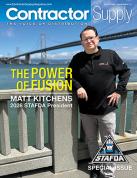
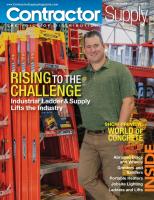

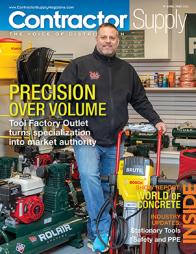
The April/May 2026 issue of Contractor Supply magazine is here!
In our cover story, Precision Over Volume, Tool Factory Outlet of Goshen, New York is a contractor supply operation built on niche brands and technical expertise.
Take a look back at World of Concrete 2026. Also in this issue are Industry Updates.
This digital edition, sponsored by BECK AMERICA Inc., is fully searchable and contains live links to every advertiser and new product listing. Click away!
| Read the Articles Read the Digital Edition |